Commercial Drone Systems: Airframe Architecture & Avionics
An engineering comparison of multirotor vs. fixed-wing UAV platforms, high-voltage battery chemistry, triple-redundant autopilot avionics, brushless motor efficiency, and mission payload capacities.
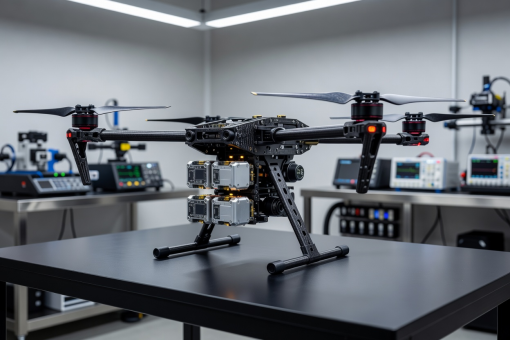
Commercial UAV Propulsion & Avionics
Commercial drone platforms operate in harsh industrial environments subject to gusting winds, electromagnetic interference, and stringent payload weight budgets. Selecting the proper airframe configuration—multirotor, fixed-wing, or hybrid vertical take-off and landing (VTOL)—requires balancing aerodynamic lift efficiency against takeoff versatility and mechanical complexity.
1. Airframe Comparison: Multirotor vs. Fixed-Wing vs. VTOL
The choice of airframe represents the foundational trade-off in commercial unmanned aviation: hover versatility versus aerodynamic cruise efficiency.
| Configuration | Takeoff & Landing | Typical Endurance | Area Coverage Rate | Primary Use Cases |
|---|---|---|---|---|
| Multirotor (Quad / Hexa) | Vertical (VTOL); requires < 3m space | 25 to 45 minutes | 20 to 50 hectares/flight | Bridge inspection, architectural imaging, confined industrial surveys |
| Fixed-Wing | Catapult / hand-launch / runway roll | 60 to 120 minutes | 200 to 600 hectares/flight | Broad-acre agricultural mapping, long-distance pipeline corridors |
| Hybrid VTOL | Vertical lift transitioning to wing cruise | 50 to 90 minutes | 150 to 450 hectares/flight | Offshore wind farms, forestry reserves without open runway clearings |
Multirotor drones expend massive amounts of electrical power simply generating thrust to counteract gravity in hover. In contrast, fixed-wing platforms use the forward airspeed over aerofoil wings to generate passive aerodynamic lift, consuming only a fraction of motor power during cruise. Hybrid VTOL airframes combine vertical hover motors for runway-independent takeoff with a forward pusher motor and fixed wings for long-range cruising, though at the cost of additional dead weight during horizontal flight.
2. Brushless DC Motors & Electronic Speed Controllers (ESCs)
Commercial drones utilize high-torque, brushless direct-current (BLDC) outrunner motors. In an outrunner configuration, the permanent magnet bell rotates around a stationary stator winding, generating high torque at relatively low rotational speeds (KV ratings typically between 100 KV and 400 KV on heavy-lift commercial platforms). This allows the direct mounting of large carbon-fibre propellers (17 to 28 inches in diameter) without mechanical reduction gearboxes that could introduce wear points.
Electronic Speed Controllers (ESCs) regulate motor speed by rapidly switching electrical current through field-oriented control (FOC) algorithms at frequencies above 24 kHz. High-tier commercial ESCs provide regenerative braking, feeding kinetic energy back into the power bus during sudden deceleration, while communicating real-time telemetry (RPM, temperature, current draw) back to the central autopilot over Controller Area Network (CAN) bus protocols.
3. Battery Chemistry: Energy Density & Degradation
Flight endurance remains heavily constrained by electrical energy storage chemistry. Most commercial drones operate on high-discharge Lithium-Polymer (LiPo) or Lithium-High-Voltage (LiHV) battery packs configured in 6S (22.2V) to 12S (44.4V) cell arrangements:
- Gravimetric Energy Density: Standard commercial LiPo cells offer approximately 150 to 220 Watt-hours per kilogram (Wh/kg). Semi-solid-state lithium batteries push this boundary toward 270 to 300 Wh/kg, offering endurance gains of 25% to 35% at increased unit replacement cost.
- Discharge C-Rating: Heavy-lift hexacopters during steep climbs draw continuous current exceeding 80 Amperes, requiring high continuous C-discharge ratings to prevent internal voltage sag.
- Thermal Sensitivity: In cold Baltic winters (-10°C to +2°C), lithium ion mobility slows dramatically, reducing available runtime by up to 40% and risking mid-air battery cell brownout. Commercial systems integrate internal self-heating elements that warm battery cells to +15°C prior to takeoff.
4. Avionics Redundancy & Autopilot Architecture
Industrial operations in the Specific Category under civil aviation regulations demand fault-tolerant avionics architecture. A professional flight controller isolates primary components across redundant physical rails:
- Triple IMU (Inertial Measurement Unit): Autopilots house three independent sets of gyroscopes and accelerometers. If physical vibration or magnetic anomalies cause one sensor's readings to diverge, voting logic isolates the failing unit and switches to the healthy IMUs without disrupting flight stabilization.
- Dual Barometers & Dual Magnetometers: Independent altitude and heading sensors protect against pitot-tube icing or local metallic interference.
- Encrypted C2 Data Links: The Command and Control (C2) link operating across 2.4 GHz, 5.8 GHz, or 4G/5G cellular bands utilizes AES-256 encryption and frequency-hopping spread-spectrum (FHSS) technology to prevent intentional interference and data eavesdropping.
5. Operational Checklist: Maintenance & Flight Readiness
| Component | Inspection Interval | Failure Criteria | Action Required |
|---|---|---|---|
| Propeller Blades | Every pre-flight | Leading edge nicks, micro-cracks, flex fatigue | Immediate replacement; never repair composite props |
| Motor Bearings | Every 50 flight hours | Axial play > 0.2mm, rough rotation, bearing heat | Replace bearing set or motor unit |
| Battery Packs | Every 20 cycles | Internal cell resistance delta > 5 mΩ; physical swelling | Retire pack from airborne service; safe discharge |
| Avionics Firmware | Monthly review | Known bug notices, sensor driver updates | Bench testing followed by hover calibration flight |
6. Advantages & System Trade-offs
Advantages
- Modular payload bays allow swapping between optical zoom, radiometric thermal, and LiDAR
- High-IP ingress ratings (IP45 to IP55) enable operations in light rain and dusty industrial environments
- Automated fail-safe protocols (Return-to-Home, GPS loss drift hold, motor-out redundancy on hexacopters)
- Hot-swappable batteries allow continuous operations without powering down the payload computer
Trade-offs
- Significant capital investment and ongoing maintenance lifecycle costs
- Weight penalties: heavier airframes require larger batteries, accelerating structural wear
- Regulatory burdens increase exponentially once All-Up Weight (AUW) exceeds 4 kg and 25 kg
- Propulsion noise levels in urban areas can prompt public complaints
7. What to Know & Operational System Selection
Selecting a commercial drone system requires an honest appraisal of operating conditions. Purchasing an expensive fixed-wing VTOL for structural bridge inspections is as inefficient as deploying a small quadcopter to map a 1,000-hectare agricultural estate. Define the payload sensor required, calculate the necessary GSD, determine the area coverage per flight window, and match the airframe to the specific spatial mission.