Drone Aerial Photography & Cinematographic Imaging
An engineering analysis of professional airborne camera systems, three-axis brushless stabilization gimbals, sensor optical formats, exposure calculations, and regulatory image capture protocols.
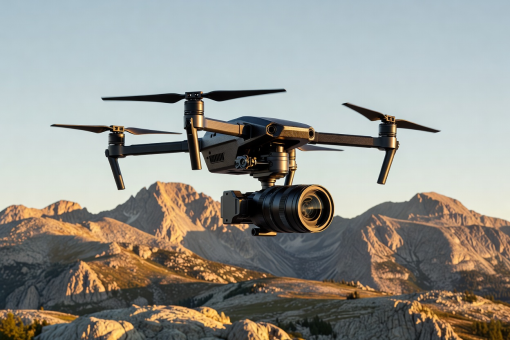
Airborne Camera Physics & Stabilization
Achieving pristine aerial imagery demands an understanding of the interaction between rapid airframe motion, propeller acoustic harmonics, shutter mechanics, and changing sunlight angles. Unlike ground photography, airborne cameras operate on an unstable platform subjected to multi-axis turbulence and high-frequency motor vibrations.
1. Camera Sensor Dimensions & Optical Selection
In professional drone aerial photography, the sensor size dictates low-light performance, signal-to-noise ratios, and dynamic range. While lightweight consumer platforms often rely on 1/2-inch or 1-inch sensors, industrial and high-end production UAVs carry Micro Four Thirds (MFT), Super 35, or full-frame 35mm sensors. A larger physical surface area per photosite allows the camera to record shadow detail across dark coastal waters or dense urban alleys without amplifying digital noise.
Optical choices must be matched to airframe stability and flight profiles. Wide-angle prime lenses (such as 24mm or 35mm full-frame equivalents) offer expansive panoramic perspectives and are relatively forgiving of subtle gimbal drift. Conversely, telephoto focal lengths (70mm to 200mm) magnify high-frequency motor micro-vibrations, requiring higher shutter speeds, tighter gimbal tuning, and stiffer airframe carbon-fibre trusses to prevent blur.
2. Rolling Shutter Distortion vs. Mechanical Global Shutters
Electronic rolling shutters record pixel lines sequentially from top to bottom. When an aerial drone flies at high velocity or pans rapidly across straight structural lines—such as suspension bridge cables, telecommunication towers, or architectural facades—the time delay between scanlines introduces geometric skew, commonly known as the "jello effect."
For precision cinematography and still capture where structural fidelity is essential, mechanical global shutters capture all photosites simultaneously. While electronic shutters suffice for high-altitude scenic panoramas with steady flight tracks, mechanical shutters eliminate motion shear during dynamic fly-bys and close-proximity orbital maneuvers.
3. Three-Axis Brushless Gimbal Mechanics
The airborne camera gimbal relies on high-resolution magnetic rotary encoders and high-torque direct-drive brushless motors operating along three orthogonal axes:
- Pitch (Tilt): Directs the lens along the vertical plane, from straight down (nadir: -90°) to horizontal horizon (0°) and slightly upward (+20° to +30° on specialized industrial configurations).
- Roll: Keeps the horizon strictly horizontal regardless of whether the drone banks during coordinate turns.
- Yaw (Pan): Isolates the camera's heading from rotational changes of the airframe, enabling continuous 360-degree panning on dual-operator platforms.
Vibration isolation assemblies—typically using silicone dampening balls calibrated to the combined weight of the camera and lens—filter out frequencies above 50 Hz generated by rotor blades, preventing motor harmonics from reaching the optical sensor.
4. Exposure Management & Optical Neutral Density Filters
In aerial environments, light intensity is often intense due to sky reflections, clouds, and water bodies. Aerial photographers face a mechanical constraint: keeping the shutter speed at double the video frame rate (the 180-degree shutter rule for fluid cinematic motion) or setting a rapid shutter speed to freeze motion in still photography without overexposing the sensor.
Neutral Density (ND) filters function as sunglasses for the lens, cutting down incoming light by precise f-stops (ND8, ND16, ND64, up to ND1000 for extreme daytime long exposures). Circular Polarizers (CPL) eliminate glare from water surfaces, glass windows, and wet foliage, revealing rich sub-surface details in Baltic coastal regions and alpine lakes.
5. Operational Checklist: Airborne Image Production
| Phase | Primary Focus | Critical Risk Factor | Mitigation Technique |
|---|---|---|---|
| Pre-Flight | Gimbal balance & compass calibration | Motor strain or horizon tilt | Physical axis balancing before motor power-up |
| In-Flight | Solar angle & wind gust drift | Lens flare & battery drain | Fly crosswind; position sun 45° off-axis |
| Capture | Exposure histogram & RAW format | Clipped highlight detail in clouds | Expose for highlights; recover shadows in post |
| Post-Flight | Data checksum & lens inspection | Data corruption or lens dust spots | Dual-card backup and optical cleaning |
6. Advantages & Physical Limitations
Advantages
- Unrestricted camera positioning between 1 meter and legal altitude ceilings
- Rapid transition between wide establishing views and tight orbital frames
- Repeatable GPS-programmed flight paths for day-to-night timelapses
- Significant cost reduction compared to manned helicopter charter
Limitations
- Strict battery endurance limits (typically 20 to 35 minutes per pack)
- Susceptibility to gusty crosswinds, precipitation, and sub-zero temperatures
- Aviation restrictions around aerodromes and congested urban assemblies
- Privacy regulations prohibiting unnotified recording of private properties
7. What to Know & Operational Good Practice
Commercial aerial photography requires strict adherence to regional civil aviation frameworks. In the European Union, operations fall under EASA Open (A1/A2/A3) or Specific categories depending on drone mass and distance from uninvolved bystanders. Flight planning must include airspace checks for temporary flight restrictions (NOTAMs), landowner authorization, and public privacy respect.